

Donor booklets in-house, and one color standard on every press
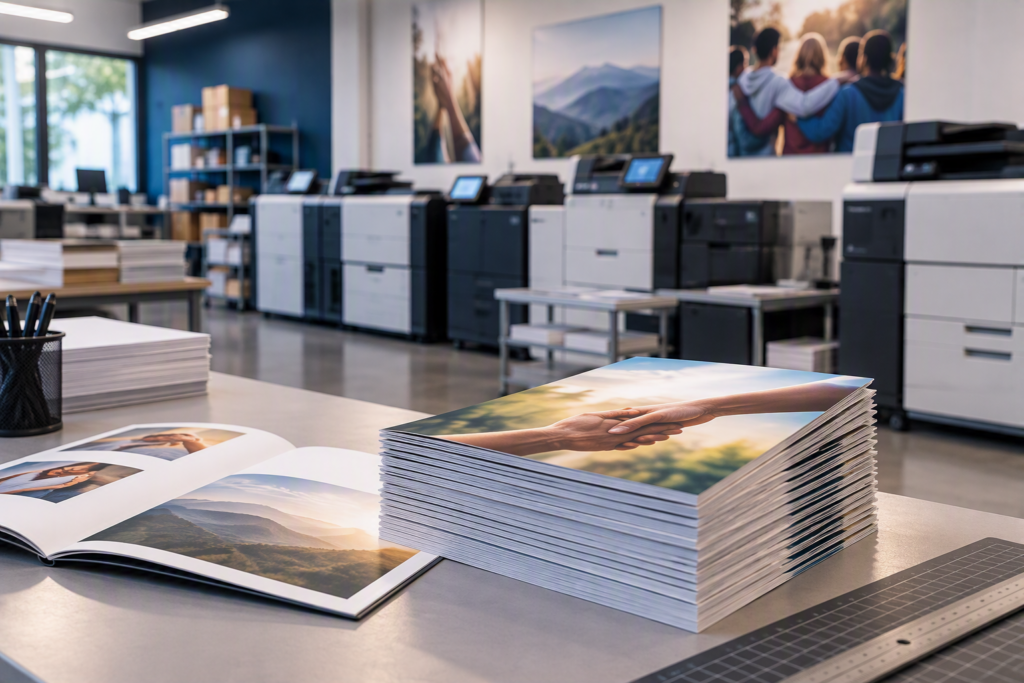
A large national non-profit brought perfect bound fundraising booklets back into its own print facility and aligned color across three presses from two different manufacturers.
Customer overview
This organization produces its own marketing, fundraising and internal communications in an in-plant print facility. Creative Services and Print Operations work side by side and hold tight control over quality, turnaround and production cost.
As design requirements grew, two things started to limit the team: color that moved from one press to the next, and specialty booklet work the facility could not finish itself.
Business challenge
Two production problems sat behind most of the lost time.
- Color moved between devices. The facility ran three digital color presses from two manufacturers and three separate product families, so matching color meant frequent manual calibration and operator intervention.
- That cost hours and paper. Manual adjustment, extra proofing cycles and reprints slowed production, and Creative Services’ color expectations were difficult to meet consistently.
- Smaller format perfect bound booklets could not be produced in-house. One press offered perfect binding, but it could not support the finished booklet size the team wanted.
- Every booklet project then had two poor options. Send the work to an outside vendor at higher cost and longer lead time, or redesign it as a saddle stitched piece that lacked the appearance the team was after.
FlexTG solution
FlexTG reviewed the production environment, equipment capability, color management process and application requirements, then proved the recommendation before the organization committed to it. The proof of concept used the customer’s own artwork and real production requirements, so the decision rested on finished samples rather than on specifications.
- Proof before commitment. FlexTG ran the requested smaller format perfect bound booklet on a production platform that supports the trim size and finishing the team specified.
- A color demonstration across the existing fleet. Automated color management profiled each of the three presses, including devices from different manufacturers, and aligned output across all of them.
- A production color press with inline perfect binding, chosen for the smaller format work and for the image quality and media flexibility the facility needed day to day.
- One workflow platform and one color standard. Job management, color control and automated setup in the workflow, with automated cross device color management applied to all three presses.
Business results
- Color is predictable and repeatable across all three presses, without extensive manual calibration.
- Operators spend far less time adjusting and troubleshooting color, and fewer color related reprints mean less paper and toner waste.
- Perfect bound booklets that were outsourced are produced in-house, which lowered production expense and removed vendor lead times from the schedule.
- Creative Services can design smaller format perfect bound pieces without production limits, capacity grew for everyday and specialty work, and new equipment can join the same color standard later.
Why it matters
In-plant print teams answer to two audiences at once: donors who judge the organization by the quality of what lands in their hands, and finance teams watching every production dollar. When color shifts between presses, the same appeal looks different depending on which device was free, and a small team loses its day to calibration.
Bringing specialty finishing inside removes vendor lead times and makes cost easier to forecast.
Request a production print assessment
FlexTG will review the applications you produce today, the equipment and workflow behind them, and what moving more of that work in-house would take.